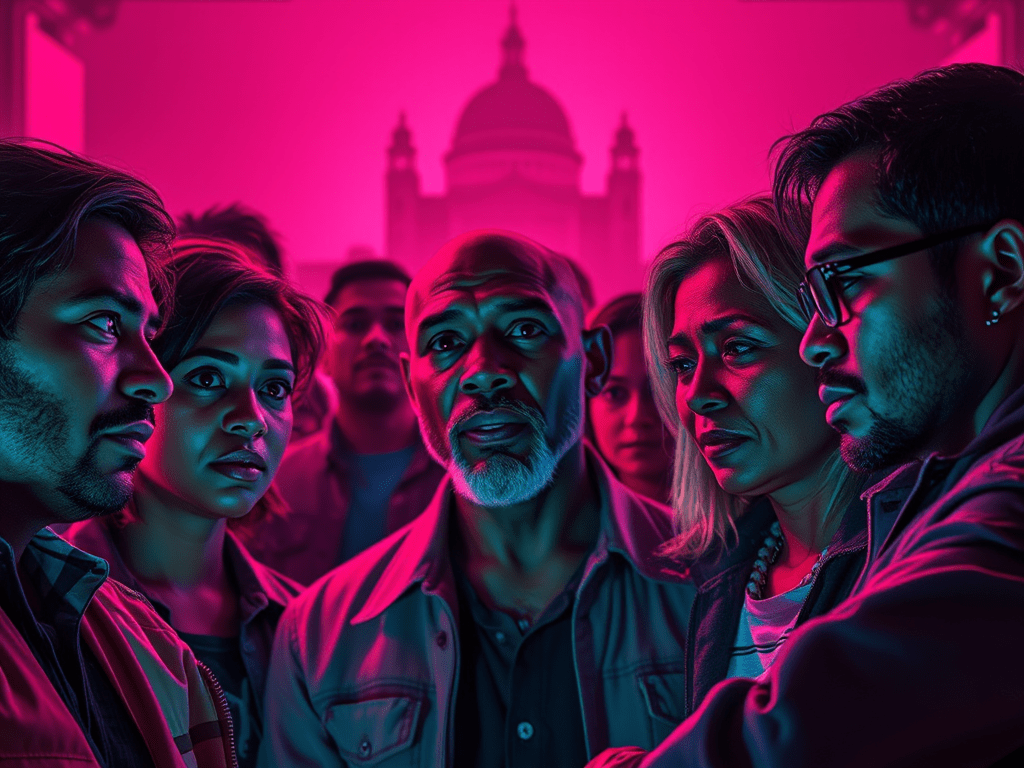
In my first post I talked a lot about the idea of good and evil, and the people and their country – many times interchanging the people with the country. The two, although consistently interchanged by myself, the media, and our culture at large, are two different entities.
In response to a question from a reporter, Francesca Albanese, the UN special rapporteur on Palestine said, “Beside this, there is no such thing in international law like a right of a state to exist […] What is enshrined in international law is the right of a people to exist.”
We have, as a nation, allowed the rights of citizens to become second in importance to the supposed rights of businesses. And yet, we don’t hold the same expectations of businesses that we hold of our citizens. We seem to have created a separate sets of rules and expectations depending on the entity and the positions people hold within different entities. An example I’d like to use is one of the Presidency. The Presidency is an entity, a position that different people can hold at different times but are granted the same rights due to that position. But it seems that we hold a different set of moral expectations for the role of presidency than we do for a citizen. As a citizen and a community member, we expect each other to be kind, decent, help, and care for the land in which we live. We see this in how we greet each other as we leave for work, pull out our trash for trash collection, mow our yards, and shovel snow for our neighbors simply because we see that it needs to be done. I recognize that this is not how we behave every day, but this is an ingrained hope whenever we move to a new apartment or buy a home. Although these are principles that we believe in, we do not, as a collective expect this of our presidents.
Instead, criminality in politics is expected to be the norm, and a tough, rude, and almost belligerent personality seems to be idealized and idolized. We, as a collective seem to believe that we must prove our toughness to the world or calamity will reach our shores. These are some deep-seated fears that I believe originate in the creation of our nation. It is something that deserves it’s own post, or more than likely, several posts to begin to delve into. For now, let’s accept that we have some deep-seated fears that reveal themselves in the ways we conduct business and the people we choose to lead our nation.
Eight years ago, SNL did a skit that was an election party where three or four liberal white people were watching the results of the 2016 presidential election along with Dave Chapelle. It ended with Trump winning over Hillary and the white people shocked as they announce that our nation is racist while Dave Chapelle and Chris Rock respond with a, well yeah kind of attitude. I am not here to argue the level of racism that exists within our country. I believe there are far more qualified individuals who have argued this far more eloquently than I could. But what I would like to argue is that Trump didn’t win because he seemed more racist or seemed to side more strongly with white ideology. He won because people see him as the strongest person who wouldn’t allow the world to bully him – and by extension, us. How could a woman, whom we all know to be an inherently softer, gentler, and less strong individual, face up against a man – a man who is 6’3”, 215 lbs (per his booking report as listed on Fox 5 Atlanta), and the owner of Trump Towers as well as an icon of reality tv who is known for saying, “You’re Fired!” Ok, some of that was a bit tongue-in-cheek sarcasm, but there are certain gender expectations that we may not necessarily adhere to on an individual level, but when faced with the running of a nation, of a celebrity personality, we allow these deeply ingrained gender expectations and mythology – which have very little basis in reality – to lead the direction of our vote. The psychology of why doesn’t really concern me. I believe it is something that we will naturally grow out of as a nation if we have the guts and courage to face our history and work on healing. But what does concern me is that we, in direct opposition to a long history that proves otherwise, believe that the world is out to get us, will bully us, and take advantage of our wealth if given even a quarter of a chance. Perhaps this is a bit of projection on our part. Seeing as this is exactly the type of actions our government has enacted while telling the population that it is for the safety and security of American interests. But I have to wonder, what exactly are those American interests? And whose? When we look back on the wars and “skirmishes” that were fought “in defense of national interests,” it seems the American citizen has never actually seen the benefit of those outcomes. However, it is fascinating to see how big businesses have benefited from those bloody battles for our supposed national interest. When did these businesses become American citizens? And when did their importance outweigh the needs, desires, and morals of our citizens?
 FrayedEdges